



Spring is always the season I am waiting for. Not only for the sunshine and blooms, but also for the annual American Physiology Summit! This year’s Summit took place in Minneapolis, the largest city in the land of 10,000 lakes, Minnesota. More than 2,500 trainees, scientists and educators gathered in the Minneapolis Convention Center to exchange their latest discoveries, foster collaborations and push physiology forward.

I kicked off my experience with the Career Day Workshop, hosted by the Careers in Physiology Committee. Nine panelists shared their journeys after obtaining their doctorate degree. They shared how they landed their current roles in industry, academia, military and consultancy. John Harrell, PhD, shared some wisdom: Have a flexible mindset and seize the opportunity presented to be successful. Nathaniel Jenkins, PhD, and Karla Haack, PhD, also encouraged us to find what fulfills us in what we do and what we’re good at. Adding a new color to this year’s program, Katie Johnson, PhD, ran a special session to help us identify the type of lifestyle that we want, and to explore the skills and logistics we need to reach our career goals.


The Summit officially started by American Physiological Society (APS) President, Robert Hester, PhD, FAPS. In his opening remarks, Hester highlighted that APS remains strong as a community and that the presence of us here at the Summit speaks to our commitment in physiology, the science life depends on. We then had an incredible opening keynote lecture by Tracy Bale, PhD, FAAAS. She shared her personal experience that drives her in her research to develop early screening tools for neuropsychiatric disorders, which was truly inspiring to me as a young scientist.

After that, I went to the Welcome Reception. I met some old and new friends, enjoyed the live strings music and the good food. What a good time to end the first day of the Summit!
Throughout the weekend, I attended multiple scientific sessions including “The Sixth Sense: Examining Interoception.” This game-changer session brought up recent discoveries of the identity of neurons that connect the brain and the body in inflammation, heart function and eating.
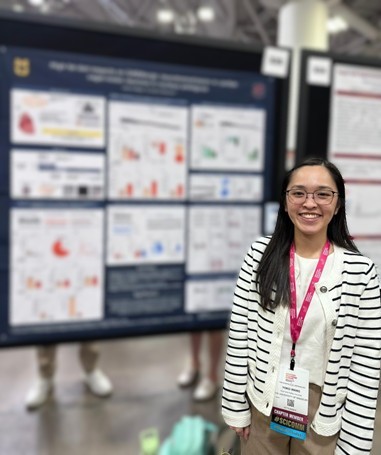
Besides learning about latest research in my field, I also presented a poster and had the opportunities to exchange ideas with peers and senior leaders in my area of research.


In between sessions, I checked out a favorite place of mine, the PhysioHub! Every year, the PhysioHub brings Society closer to the members. You will also find ”must-do” perks like the photobooth. This year, they also had wall climbing and free massages for all attendees!

Closing my last night in Minneapolis, I attended the Neural Control & Autonomic Regulation (NCAR) section banquet. Members of the NCAR Section gathered to celebrate achievements and catch up with fellow colleagues. Undergraduate students to established researchers all mingled and shared their Summit experience over a drink and a few bites. John Osborn, PhD, and other NCAR members from Minnesota capped the night by thanking all of us for the support and our presence at the Summit this year.
Four days went by very fast, and it’s already Sunday. Robert Hester again stood before us and shared the remarkable progress we had made in just a few days. More than 650 APS members raised their voices to Congress to advocate for science. Hester passed the leadership torch to incoming APS President Sue Bodine, PhD, FAPS, FIUPS. He also announced the Susan M. Barman Professional Opportunity Award for Research in Central Autonomic Neurophysiology, an award made possible by the generous $300,000 gift by Susan M. Barman, PhD, FAPS, a former APS president.

Jennifer Lippincott-Schwartz, PhD, FBS, FRMS, FASCB, gave a closing keynote lecture about engineered messenger RNAs that have multiple colors like a rainbow, which helped her to discover the hidden world of the cells. The end of her lecture marked the closing of the 2026 Summit. This space was where we shared memories and our #FightForPhysiology.
Hope to see you all at the 2027 Summit in Denver!

Yoko Brigitte Wang, PhD, is an assistant research professor at the University of Missouri. She studies the vagus nerve and is passionate about understanding the vagal sensorimotor integration in the brainstem and multiorgan crosstalk. Wang served as a meeting blogger for the 2026 American Physiology Summit.